Superteach's Special Ed Spot: #WETEACHSPED. special education

Showing posts with label #WETEACHSPED. special education. Show all posts

Summer Surprise Bundles


SUMMER!  Have you reached that goal we yearned for each day? Summer, the time to relax and rejunvenate. But first, I want my students to have something to work on through the summer so I want to put together a summer kit for each one of them.
1. First I start with the container. Sometimes I purchase a blank lunch box but I find those difficult to find. Other things I have used are new blank paint can, small colored pails.
1

Reinforcing Behavior and Academics


Token boards are a great way to increase compliance with non-preferred activities in the classroom and at home. They provide students with a visual means of telling when and how they will receive reinforcement. 


What's a Token Board
A token board is a visual system that shows progress toward a reinforcer with tokens earned for completing behavioral and academic tasks. They act as a visual reminder for the student about how close they are to the reinforcer. It helps to keep them more focused and reinforce positive behavior. The token board is an awesome way of decreasing those verbal reminders we constantly repeat to students, of what is expected. Instead of repeatedly stating your expectations,  point to the token board, saying "When you finish 2 more words you may....".

I first started using token board systems to increase positive behavior while in the halls and special activities such as music, lunch, art, and P.E. It worked so well, I soon extended it into the everyday activities of my classroom.
If I had an unusual behavior I wanted to work on with a particular student such as sitting in a chair, I used a token board first. And many times, it was perfect!

 There are many different types of token boards you can use. There is no one correct type. Use what works best for you and your students. I usually use very simple token boards to eliminate artwork that may be distracting. Some students will work harder if the token board contains pictures they like. You may need to experiment to see what is best. You may need a variety of types of token boards to meet the needs of your students because as we all know, no 2 students are alike. One of the greatest things about token boards is they are so modifiable. They can be super simple or more complex to meet the need of the task/behavior and student.  A token board should include the following parts.
  • A reinforcer/reward section - what is the student working for
  • Tokens section - what tokens  have been earned
  • Quantity of tokens needed- how many do they need to earn?
Here are a few of the token board series I frequently used. The cards have different amounts of token spaces on them so I can use them to increase the work/behavior reinforcers as the students become successful.


How to use Token Boards:

  1.  Select a reinforcer the student is interested in. Perhaps you have a student that loves princesses. Then perhaps having a princess on their tokens will be particularly motivating to them. Dinosaurs, pennies, keys, smiley faces, Sponge Bob Square Pants, Thomas the Tank Engine are just a few of the other tokens I have used. 

    I often had a board in the classroom with the token reinforcers that were available. The students could select which one they wanted to use on their token card. Making sure the token reinforcer and end reward is motivating to the student is key to token boards being successful.
  2. Select the behavior or task you want to be completed. It's important to use one that is attainable and broken down to the simplest step. (e.g. If you want the student to complete a math assignment of 4 tasks or problems, but they can't complete 2 make sure to work on completing 1 first then build up to 4 when 2 and 3 tasks have been mastered.
  3. Each time the student successfully completes the requested task/behavior then hand him a token to be placed on the board. (e.g. If you are working on sitting in a chair. 
  4. Keep the board in view for the student to help with attention.
  5. When the student has earned the designated amount of tokens, give them the agreed upon reinforcer.

Teaching Token Boards:
  1. Two options
    A.  Begin with a token board that is almost complete. If using a 5 penny board, for 1 example, pre-load the board with 4 pennies. When the student performs the desired behavior, place another penny on the board and immediately reinforce the student. Always place the penny on the board in view of the student and pair with verbal reinforcement each time.
As the student becomes more familiar with the token board, preload the board with fewer pennies until you reach the student’s current ability level. The ultimate goal is to start with an empty board.


B. Begin with a token board with minimal spaces for token such as 1 or 2. As you progress, you can change the card to other with increasing amounts of token spaces on it.
When introducing the token board, the teacher may manipulate the board and tokens. As student understanding of the token board increases, allow the student to manipulate the board and tokens.

Token boards can be used in a variety of ways and lend themselves easily to many different situations. How do you use them in your teaching?
2

4 Unconventional Data Taking Methods - Make Data Work for YOU!


Keeping track of data - thats what we need to do as special education teachers. Finding the way that works for you, your system, your students, school and administration is what matters so this is part 2 in exploring some ways to record data in special education classrooms.

Last time we touched base on a few classroom methods that could be used when doing 1 on 1 work or small group. Today lets look at some different types of collection.

Have you ever made a bulletin board that records students results? My kiddos just adore it. In my class we usually used color codes to represent the students, so no information is given away.

Here is an example of data collection for word families. Each student would have one of these on the wall or bulletin board. You could even put them in a student data book or portfolio.

The color of the grapes could be color codes per student and affixed to the the vines as the student learns the words. In this case this student was working on -AT word family words.
This also works well when you are teaching Aesop fables since you can integrate the Aesop fables, word families and data collection all in one.


When its time to collect data - all your information is located on your bulletin board or in a data book. Easy and convenient.

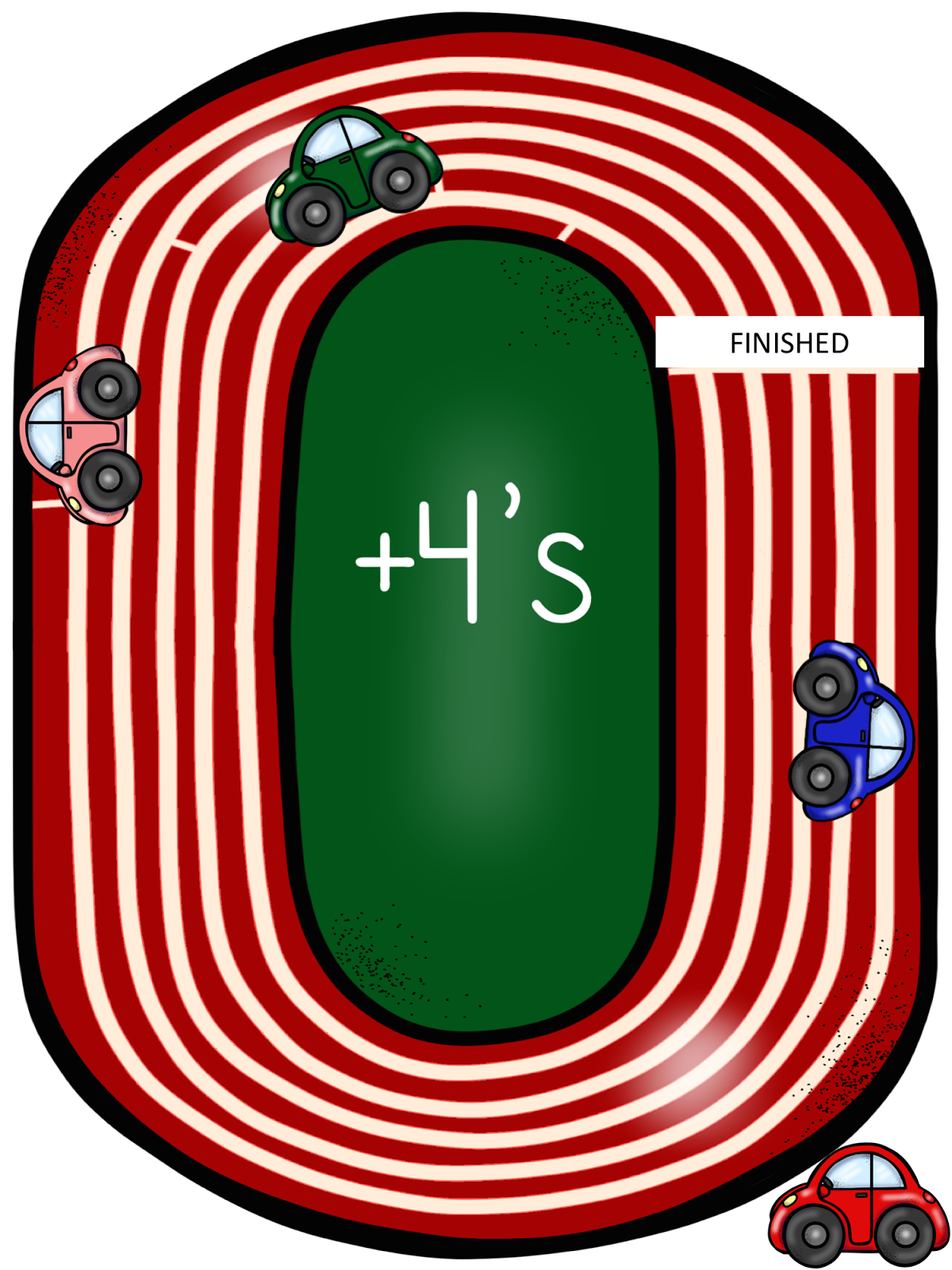
2. Here's an example of data collection in which everyone's results are on the same board. Here everyone is working on learning addition of 4's. You make one racetrack and each student has a car emblem. This car can have their name on it or it can be color coded to match the coding system in your classroom. You can choose how to divide the racetrack up to denote learning all the facts in the 4 addition tables. As the students learn them, they can move their car further on the race track.
If they learn they learn them all, their car gets put off the track at the bottom of the board or note book page. 
Easy to manage and helps decorate the room as well.

3. Paper Clip Collections
Here is an easy way to collect data. Using just two colors of paper clips (could also use 2 sizes of clips) I have often used this method by keeping the paper clips on a table near me. When the skill is  achieved or mastered, I can pick up the appropriate color paper clip and move it to a different pile or fasten it on a paper. When the answer is given incorrectly, I can use the alternate color. 
This will immediately give me the percentage to record by quickly looking at the paper clips. 

4. One way I used to collect data was giving each student a behavior ticket. I focused on specific  character skills (be honest, be kind etc) each week. Each day the students were required to share with me in the their way, how they did that. For some students they need to point to someone they were kind to, or write down what they did. How they answered for this depended on their individual skills but if they mastered the skill, they received a pre-determined number of hole punches in their ticket. We called it "Ticket Out the Door" as we did it right before dismissal as a way summarize the day. 

Counting the holes punched at the end of the day or week, you can quickly and easily see how the student is doing. These are available in my store at Data Collection Hole Punch Cards .


What types of data collection tricks do you use to make the data collecting easier?


2

BRINGING THE WORLD TO OUR STUDENTS


TEACHING THE WORLD THROUGH
SOCIAL STUDIES

I LOVE teaching Social Studies! I especially enjoy finding ways to make the historical part of it come alive for kids.  Teaching Social Studies to any elementary student can be challenging to make the facts and details of history become meaningful in today's world. Helping students with significant disabilities master these skills can often present  their own set of unique challenges when compared to other subjects. It is a subject that can seem unreal and complex to many students. What I try and do with Social Studies is to teach it subject in a simple, factual way so our students can comprehend it on their level with their disabilities.

Today, let's look at a few ideas that have worked in my classroom. Whether you work with students with disabilities in the general education setting or in the special education classroom with students that have more significant disabilities, making the concepts in Social Studies as real as possible is important.

 Do you work with students  with disabilities in the general education setting; modifying the curriculum to meet the needs of your students?
First you want to make certain you have considered the degree of  disabilities the students in your classroom have and how this will significantly impact  teaching the social studies concepts. Working with students in the general education classroom or in a classroom with students with significant disabilities is very different.  Here are just a couple of ways.

SOCIAL STUDIES TEXT

Social studies texts  can make it difficult to rely on them in teaching this subject.  The ones I have used; even those geared toward lower grade levels often presented information  at a much higher reading level than the grade for which they are intended. 

This makes it difficult for students without disabilities. Add to that, our students in special education that don't read on grade level even when looking at presenting it to students in general education classes with no disabilities. 

Many special education students receive their Social Studies instruction in the general education classroom with their peers. Others receive it in the special education classroom, but need to be working on similar concepts as their general education peers. Still other students receive social studies instruction in the special education classroom, but are working toward alternate standards and concepts. No matter where the instruction takes place, these ideas are for you!

Concepts in social studies often require higher level thinking skills to comprehend them.
How can we help our students with disabilities meet these challenges both in the general education classroom and in the special education classroom?

IDEAS FOR BRINGING THE WORLD TO OUR STUDENTS

Here are a couple of ideas.
Music -
Songs  are a spectacular way to teach concepts. I find that songs set to well-known tunes work particularly well. The kids usually already know the tune so we can concentrate on the content.
Because of the familiar tunes of these particular songs, I found it leaves student able to concentrate more on the words and any visual that you may use to help the students learn the materials. Here are a few of my favorites I have used in my classroom.
Here's a song I used to teach continents


Continents
Asia, 
Africa, 
Antarctica
Australia, 
Europe, too
North America
South America
Seven Continents for you!

Set to the tune of the well-know Pop Goes the Weasel, this song has just the facts I wanted to teach, a tune the students were familiar with and it quickly became one of the kids' favorites that at times, we even heard it being sung in our classroom bathroom.


Cinco de Mayo
Cinco de Mayo,
Cinco de Mayo,
The fifth of May,
The fifth of May
Is the anniversary
Of a great victory
For Mexico.
For Mexico
To the tune of Are You Sleeping, this is a very basic song about Cinco de Mayo, but depending your the level of your students, you are still teaching when it is and the country it is associated with.
Mnemonics
A mnemonic can be anything from an abbreviation, rhyme or even an image that can help you remember. We all know them and have probably used them from time to time. How do we remember the steps to use in long division? What about a mnemonic to remind us how to spell a word? ( i before e except after c) How do we remember how many days each month of the year has? (30 days hath September, April, June and November...) Have you used any of these? 

Here is one teaching the continents.

Eat An Apple As A Nightime Snack

The first letter of each word represents the name of a continent
Europe
Antarctica
Africa
Asia
Australia
North America
South America

There are so many ideas out there, I could go on forever. What are some of YOUR favorite ones to use?
We have a whole world of ideas and history to teach our kids. Find some song and rhymes that work for you and have fun!
0