

I like teaching Reading to my kiddos, but I LOVE teaching Math!
I think its a favorite of mine because Math is more hands on.
So many parts of math are visual or can be made visual, making it a little easier for kids to grasp it,
Today I want to share with you a few things that have worked for me teaching math with my students.
ROTATION
There is a multitude of levels in a special education classroom, its often difficult to work in whole group or even small groups so I form a rotation schedule for the math portion of my day. I like to work with kids in Math on an individual basis so I started using a rotation schedule.
I usually designed the math class to operate on 15-20 minute intervals. Keeping the time segment to 20 minutes or less, makes it long enough to teach substantive skills yet short enough for young minds attentions issues.
DIRECT INSTRUCTION
I work with each student daily. Part of my daily math schedule is a 1 on 1 time with each child. I do a skills assessment at the beginning of every year. This gives me an idea of what skills they have retained over the summer, what skills they've gained and where we need to start this year. For direct instruction, I primarily use materials I have made specifically for my students, but in addition to those materials, I also have used Touch Math. If you aren't familiar with it, Touch Math is a supplemental program, that has been around for about 40 years. In my opinion working with Touch Math and its multi-sensory approach makes it perfect for kids in special education classrooms. The multi-sensory piece of the program is primarily a patttern of dots and rings called Touchpoints.
One of the first things you teach in the program is how to use the Touchpoints™. There is a specific sequence to touching, saying and counting for each numeral. Once this is learned, the world of math is at the fingertips of many students that once had difficulty with it. In Touch Math, dots are touched and counted one time and a dot with a ring around are counted once for the dot and once for the ring around the dot. Addition is taught using the count-on strategy and subtraction is used with a counting backward method. They also teach multiplication as well as money.
Be sure and check them out at Touch Math .
2. REVIEW & PRACTICE
First thing I do is set up a way for my kids to practice their skills on a daily basis. Sometimes we called them Bee Boxes, other years we call them Math Boxes or Task Boxes, but the purpose is the same. The students rotate through the boxes daily practices through short activities or "games" the skills they are already been taught but need to revisit to maintain mastery. Each math box had a different skill or a repeated skill at a different level. Bee Boxes were operated so that no child did the same skill twice in a row in one week. The best way it was managed was when the skills were repeated for 2 days, on Wednesdays and Thursdays, a second set of skills was practiced then on we had a review day on Friday.
One of the schedules I used was this sea creature schedule. Each Math Box was a sea creature and the station sign (seen below, left ) was over the table or area where the Math Box was located. Here's an example of what my Math Stations might look like.
Station 1 was teacher instruction,
Station 2 was putting numerals in order,
Station 3 was counting items and labeling,
Station 4 was Working with a teaching assistant,
Station 5 was determining more/less of a group of items
Station 6 was putting numbers in order.
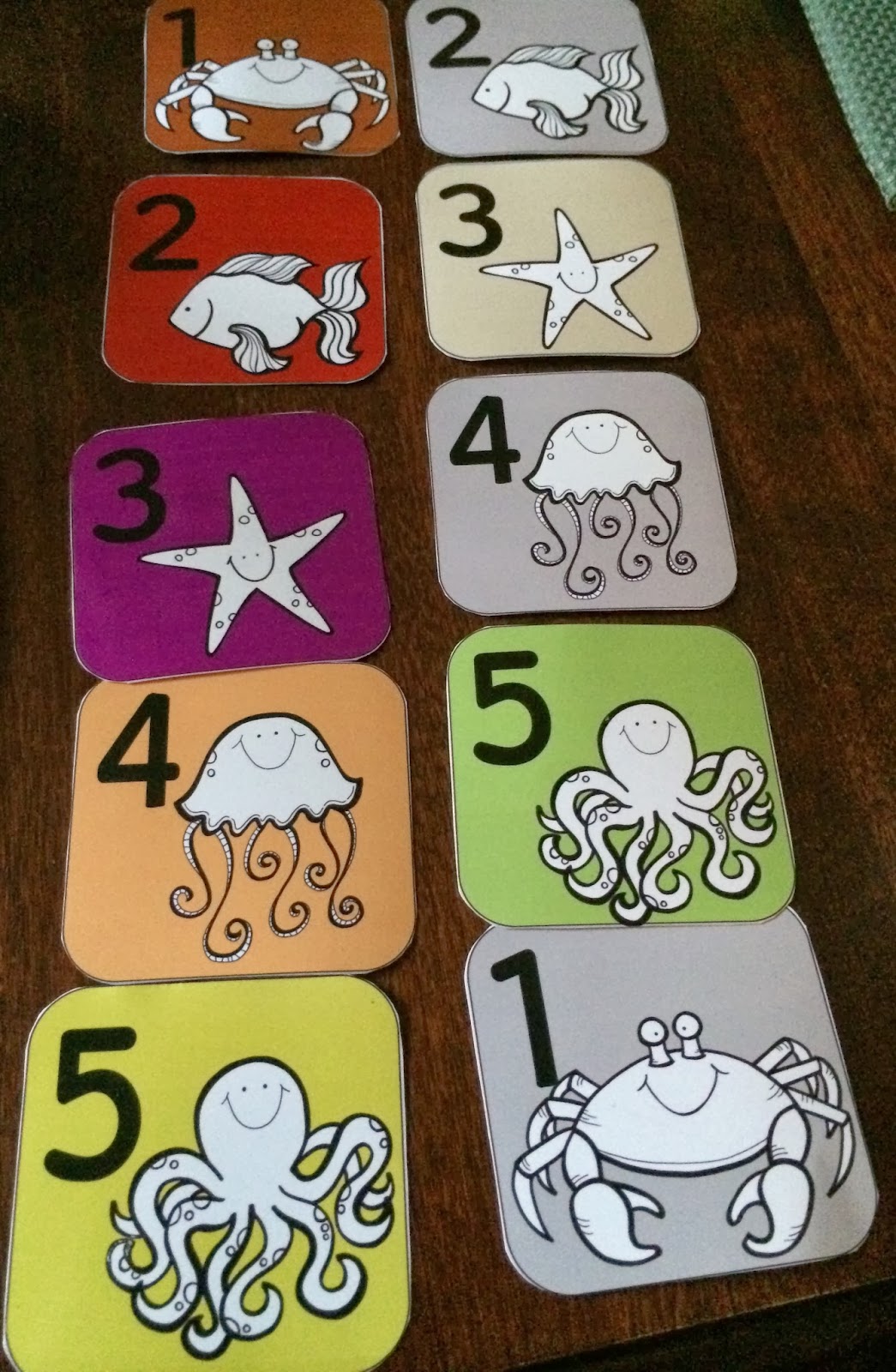

Each student had a set of schedule cards such as the ones (Right). The picture and the number on the schedule card told the students which station to go to and the order of the line of schedules told them which order to do them in. As you can see in the picture on the right, the centers are rotated by moving the top one down to the bottom. These schedules are available in my store all ready to print and laminate. Check them out here:
Visual Task Schedules
Some of the items I put in my task boxes are things such as task cards like the ones below. When used as task cards the 4 cards are cut out separately and laminated. Then the students can use wipe off markers or clothes pins to mark the correct answers. The picture below shows my task cards before I cut them apart. I took each page and put them on the iPad the classroom has. Then the students can write on the iPad with their fingers to circle the correct answers. This leads me to the last section of my Math class rotation.

TECHNOLOGY
The 3rd section of my math class is devoted to practicing the math on the computer and/or iPad. I was very lucky to have 3 iPads and 4 computers in my classroom. So I utilized them everyday but using program such as ScootPad which is a website that provides personalized learning in both reading and math. The personalized portion, of course was of great importance since my kids were not working on grade level so I need to be able to manage exactly what they work on. ScootPad has a free version which works just fine and a paid version which is awesome.
Another good option for working on Math with technology is MobyMax. TouchMath also has software that goes along with their lessons.
Hope you have found some tidbit of new information that can help you in teaching Math n your class.


