Superteach's Special Ed Spot: differentiation

Showing posts with label differentiation. Show all posts

Grouping - Making it All Come to Together


How many students do you have in your classroom right now? 
We know as special educators that we have kids with all types of needs, abilities, deficits,  academic levels, independence levels, social skills, with different IEP goals, objectives and a multitude of  different PERSONALITIES and behaviors in our classrooms.
So much of our time is spent working with these children one to one. There are times when we need to work with the entire group of students - no matter what the skill level, age or grade level.
How do we take all of those factors and put them together in a cohesive group so the instruction take place? How do we make it all come together.
Today I want to talk about grouping. With as many students as we often have in our classrooms, and so many levels of students, individualized teaching is often the way to go, but grouping students is still possible even with many different levels.


One of the most common times I need to have all my kids together in one group is during Morning Meeting. So today,  I want to focus on ways to differentiate Morning Meeting.

Here are 3 things I have done to make whole group instruction work

1. Morning Meetings on the SmartBoard

Being a tech nerd, I have always tried to integrate new tech equipment into my classroom as soon as it was available. The Smartboard was no exception. I spent many hours searching on the Smartboard share boards for Morning Meeting materials and usually found kindergarten or first grade level materials  that would work for my kids.
 I had about 10 kids ranging from Kindergarten to 5th grade with academic levels no higher than 2nd grade. Most were verbal but some were not and patience for waiting their turn was a hard skill for some to learn.  One or possible 2 people at the board - meant others were sitting in their seats in front of the board. This often posed a problem. How do I keep them all engaged and allow the children who are non verbal a way to participate?

SOLUTIONS

  • Making almost all of the answers on the SmartBoard drag and drop or push to activate buttons. The SmartBoard allowed the children with low verbal skills an opportunity to go to the board and drag and drop and answers so they too could participate. 
  • Making individual Smartboards for the kids that had difficulty waiting with individual pieces provided those having difficulty waiting their turn, a similar activity to do while waiting.  For example, while the Interactive board was being used to put the days of the week in order, the  students with individual "smartboards" were putting  their own visuals of the days of the week in order on their boards. 
  • Today, this is very easy to do with a tablet when necessary. Each student had an iPad with the pages of the Morning Meeting on it and could drag and drop their own pieces where they needed to be. 

2. Individual Interactive Morning Meeting Notebooks

Another way I use to include each student in a group activity is to create an individualized interactive notebook for them.  We had 5 pages for Morning Meeting in the notebooks. 
Page 1 - Yesterday, Today and Tomorrow
Page 2 - Today's Date
Page 3 - My Name is 
Page 4 - Today I feel
Page 5  Today's Weather


As skills improved, more pages and higher level skills were added individually and group-wide. 
This was great because each child had a notebook designed at their appropriate level and each child was engaged throughout the entire activity.

3. Special Activities in Morning Meeting

On special days when we might be learning about a new topic or holiday, I often made fact books about what we were learning about such as a book about Martin Luther King Jr when we were learning about him. 
I made a mini book about the topic using basic sight words as much as possible. Some of the pages would be too hard for some of the students so their books had pages with visuals accompanying the words to make it easier for them to participate and understand the topics. 
This way all the students were participating in the activity and on their individual level but we were able to conduct the learning activity as a whole group.

These are just a few ideas that worked great for Morning Meeting activities but also worked well for other activities. Try them out.

What do you do in your classes to make whole groups effective with a myriad of levels? 


1

EXTRA SALE DAY!!!!


An extra day of the great sitewide TEACHERS ARE HEROES sale at TPT.  All of my products are discounted 20% but be sure to use the code HEROES when checking out and you will get a total of 28% off.
https://www.teacherspayteachers.com/Store/Superteach56

1

Marvelous Monday!


As I have become overwhelmed working on IEPs differentiating work for my students, getting prepared for a new student tomorrow, OPEN HOUSE on Thursday and many other things, I am sure all of you are going through as well.
So today I am repeating a post from this summer that bears repeating as it is such a vital piece of what we do.
 Happy Marvelous Monday everyone!

  • CCSS.Math.Content.K.CC.B.4 Understand the relationship between numbers and quantities; connect counting to cardinality.
    • CCSS.Math.Content.K.CC.B.4a When counting objects, say the number names in the standard order, pairing each object with one and only one number name and each number name with one and only one object.
    • CCSS.Math.Content.K.CC.B.4b Understand that the last number name said tells the number of objects counted. The number of objects is the same regardless of their arrangement or the order in which they were counted.
    • CCSS.Math.Content.K.CC.B.4c Understand that each successive number name refers to a quantity that is one larger.
While this is a kindergarten Common Core skill, those of us in special education know we are often working on this skill  beyond kindergarten age and grade level, so it's important to have many types of materials so kids won't get bored  over time, doing the same activity. My students needing to master this skill are a mixture of grade levels; some kindergarteners and some older.

How can I differentiate this concept?  One way I can do this is to vary the product (outcome) I expect from the students in order to demonstrate their learning. I may need to have multiple ways to differentiate this within my group of students, also. So I need lots of options.
Many of my kids groan anytime I show them a worksheet to do, but will volunteer to work on something if the activity looks like a game they can play. For one of my activities, I made a set of counting task cards.  My kiddos love these!
Now, I can look at differentiating this one activity's outcome. How can I differentiate the learning in order to make more gains in learning?
Here are some starter ideas:
  1. I can differentiate by having them write down the answers on an answer sheet.
  2. Use them as task cards and attach clothespins to the correct answers. 
  3. Place them  in a learning center area or independent work area where I assign certain students to complete the cards. Following completion of the cards, I can check the student's work before they leave the work area.
  4. Assign certain sets of of the task cards (e.g. counting 1-5, counting 6-10) to specific kids so the materials meet their individual learning needs.   
  5. I could also make them into a game such as the card game, War.
    If you didn't played this during your childhood as I did,check out the rules at http://www.bicyclecards.com/card-games/rule/war
  6.  With multiple sets of the task cards, you could teach a group of kids to play the card game, Go Fish. See game rules: http://www.bicyclecards.com/card-games/rule/go-fish.

Its Marvelous Monday  and here is your Freebie for today!


Enjoy this Mini-set of my Number Concept task cards for free. If you would like the entire set, please check out the item at my TPT store: 

http://www.teacherspayteachers.com/Product/Number-Concepts-1-10-Task-Cards-604922

  Don't forget to check out our good friends at Classroom Freebies and Manic Monday! You never know what goodies you will find there!

Classroom Freebies Manic Monday
2

In the End - Get What Your Students Know!

Hi Guys!  Happy Marvelous Monday!!!
Hope everyone had a great weekend.  Today I thought we'd finish up our series on differentiation by talking about the final product.
How many of you when you went through school always demonstrating your knowledge to  the teacher by taking a test to show what you knew?  I know I did!
Now how many of you were not good at taking those tests?  I sure wasn't good at it!

Today we still have those tests and hardly anyone is good at showing all they know through them. Even in today's world of test, test, test, we need to remember that our kids can not demonstrate all they know on paper/pencil tests.

Differentiation is the answer. Differentiating the outcome, the product, of how the students show you what they have learned is one way to combat this. What is the best way to get the most out of your students for the topic you are teaching?

Ways to differentiate Products 
Most of my students dont like to write, so practicing/test  their spelling/vocabulary words can be a battle. . Some of them have difficulty writing legibily due to fine motor problems, some aren't at the writing stage developmentally yet and some have vision issues. So when I  develop a lesson for them to practice words on a daily basis, I take these issues into account.
What are some ways I can differentiate this lesson? Here are some things I do for this subject, but they work for others as well.
Whiteboard
  1. Let the student write on the white board. Some kids love writing on whiteboards, smartboards, tablets and more.  
  2. Have them write the words in sand.
  3. Use clay to spell the words.
  4. Use magnet tiles. I have blue magnet letter tiles from Lakeshore Learning that have been absolutely wonderful for many years. I also purchased a small magnet board from them that is easily portable and stands on a desk.
  5. Student love working on projects. We did plants last year and instead of asking them to give me the plant parts on a paper/pencil test, we used the real plants. They loved it and I loved it.
  6. Technology is an awesome way to differentiate. I utilize iPhones, iPads and computers in my classroom daily. This year I am incorporating QR code in my classroom. QR codes will be part of daily activities as well as assessment and end product.


    Plants
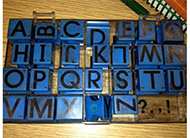
    Rubber Stamps


As part of Marvelous Monday Freebie - please find a below a link to my latest QR product for Alphabet Letters and sounds. Check it out and let me know what you think. If you like the freebie you can find it in my TPT store.

QUESTION OF THE DAY - 

What are some ways you differentiate the end products of units you teach? I would love to hear what you do!


0

7 Bright Ideas for Differentiation

You can differentiate many parts of your teaching. You can differentiate what you teach by varying the the way the content and how it is delivered,  the processes you use to teach it, and you can differentiate the outcome or the product that you require the students to produce.
 Today I want to focus on differentiating how the content is accessed. How can we vary  access to meet the needs of our students with many different learning styles?
Varying the content can mean modifying how the student(s) will gain access to the subject matter.

 Vary the Modality of presentation   

Will you teach the material auditorily or will the presentation of the materials be primarily visual?  Everyone has a different learning style; whether its visual, auditory or kinesthetic/tactile.

7  bright  ideas to differentiate content and how it is accessed.


  1. Vary the presentation
    Some students best gain information when it's presented auditorily. Use a language master (tutorette), tape recorder, iPad, iPhone, CD player, to record the information you want presented. This way students can listen to the materials multiple times. In this picture the card is inverted so the the audio tape can be seen. This is the portion normally put through the slot of the machine.
  2. Chunk-it! Present vocabulary/spelling words on the readability of the student. Vary the number of words the student has to master. Give the student only a portion of the words. Then when those are mastered, proceed with the next chunk or the remainder of the words. For example: if your lists are normally comprised of 10 words, try giving 5 then the remaining 5. Work out the combination that works best for the group you are working with.

  3. Interactive Presentations
     Include computers and interactive white boards such as Smartboards or Promethean Boards in your presentations.

  4. Hands-on Activities
    Use hands-on activities for students to master the content. Have them draw, build a model, or do an experiment. Have them show you what they know.Use clay to practice vocabulary/spelling words. Have them trace the words with their fingers.

    Clay spelling words
  5. Reading Buddies
    Using reading buddies Have the students read the content to each other and then report to the group, to you or to the entire class what they have read.

  6. Flexible Small Groups
    Meeting with small groups to re-teach an idea or skill for struggling learners, or to extend the thinking or skills of advanced learners. Don't leave your groups the same, always be looking for groups in which student will learn best. Different concepts, different learning levels, different groups. Multiplication and addition groups won't necessarily be the same.

  7. Task Cards
    Use task cards geared at different levels. Task cards are a great way to differentiate among your students. I often color code my task cards or give them a code to indicate the group they belong to. This makes it easy to clean up and easy to dispense to groups. Card 1 has a zigzag border to indicate the group it belongs to.
    Task Card #2 has a polka-dot border to indicate its group.
Task Card Picture #1 -  Lower Case to Upper Case Card

Task Card Picture #2 - Upper Case to Lower Case Card
 These are just a few ways to differentiate the presentation of content. These are just a couple of the ones that I love and utilize on a daily basis in my classroom.

What are some of your favorite ways YOU DIFFERENTIATE  how you present materials? Leave a comment and share what YOU DO!!!


0

MARVELOUS MONDAY FREEBIE!!! - Differentiating

As I have become overwhelmed working on IEPs differentiating work for my students, getting prepared for a new student tomorrow, OPEN HOUSE on Thursday and many other things, I am sure all of you are going through as well.
So today I am repeating a post from this summer that bears repeating as it is such a vital piece of what we do.
 Happy Marvelous Monday everyone!

  • CCSS.Math.Content.K.CC.B.4 Understand the relationship between numbers and quantities; connect counting to cardinality.
    • CCSS.Math.Content.K.CC.B.4a When counting objects, say the number names in the standard order, pairing each object with one and only one number name and each number name with one and only one object.
    • CCSS.Math.Content.K.CC.B.4b Understand that the last number name said tells the number of objects counted. The number of objects is the same regardless of their arrangement or the order in which they were counted.
    • CCSS.Math.Content.K.CC.B.4c Understand that each successive number name refers to a quantity that is one larger.
While this is a kindergarten Common Core skill, those of us in special education know we are often working on this skill  beyond kindergarten age and grade level, so it's important to have many types of materials so kids won't get bored  over time, doing the same activity. My students needing to master this skill are a mixture of grade levels; some kindergarteners and some older.

How can I differentiate this concept?  One way I can do this is to vary the product (outcome) I expect from the students in order to demonstrate their learning. I may need to have multiple ways to differentiate this within my group of students, also. So I need lots of options.
Many of my kids groan anytime I show them a worksheet to do, but will volunteer to work on something if the activity looks like a game they can play. For one of my activities, I made a set of counting task cards.  My kiddos love these!
Now, I can look at differentiating this one activity's outcome. How can I differentiate the learning in order to make more gains in learning?
Here are some starter ideas:
  1. I can differentiate by having them write down the answers on an answer sheet.
  2. Use them as task cards and attach clothespins to the correct answers. 
  3. Place them  in a learning center area or independent work area where I assign certain students to complete the cards. Following completion of the cards, I can check the student's work before they leave the work area.
  4. Assign certain sets of of the task cards (e.g. counting 1-5, counting 6-10) to specific kids so the materials meet their individual learning needs.   
  5. I could also make them into a game such as the card game, War.
    If you didn't played this during your childhood as I did,check out the rules at http://www.bicyclecards.com/card-games/rule/war
  6.  With multiple sets of the task cards, you could teach a group of kids to play the card game, Go Fish. See game rules: http://www.bicyclecards.com/card-games/rule/go-fish.
For our Marvelous Monday Freebie please enjoy a sample of my counting task cards. 
Click for your Marvelous Monday Freebie:


Its Marvelous Monday  and here is your Freebie for today!


Classroom Freebies Manic Monday
0

Differentiation What Is it? Part 1

Some people think differentiation is a new way of teaching. Differentiation has been around for many years. It is nothing new. At one point in time it was generally thought that differentiated teaching was just for teachers in special education. Grade level classroom teachers often taught their content one way to the entire class. Those students that mastered the content got it and those that didn't were left behind. However with the inclusion of more students with disabilities in the general education classrooms; some teachers find themselves face to face with differentiation and implementing it in their classrooms for the first time. Gone are the days of cookie cutter teaching where you have one method to teach and just plug the kids in and see if they succeed.

Differentiation is varying the teaching methods and end product expectations for different students.  Differentiation addresses the learning needs of the many.  It is a way to meet our students' multitude of learning needs taking into account their learning styles, interests, experiences and abilities.
Differentiation is CHOICE.

 This is going to be a multi-part series on differentiated teaching. Please feel free as we go through the segments in the coming week, to post comments and experiences you have had with differentiated teaching in your classroom. LET ME HEAR FROM YOU!

In order to meet the needs of a variety of kids, we first have to know what have they learned about this topic already. How much can they do before I even begin teaching this concept.  In order to do this we first have to know the strengths and weaknesses of each of our students. Pre-assessment can give us an idea of what information a student knows about a specific topic. Pre-assessment can be as easy as a KWL chart where you have a discussion with the class about what they KNOW now about a topic, what they WANT to know, and then after the skill has been taught, what has been LEARNED. KWL charts could also be done as a large group, small groups or even individually as a worksheet. See the example of a KWL chart below. Grab yours for free! Click on the image.
KWL Chart
Pre-assessment can also be a pretest such as before a math chapter or one you make up.
Once you have an idea of what your students currently know, you can structure your teaching unit to meet the needs of your students.

Use materials that utilize  a variety of modalities in your teaching. All of us have strengths and weaknesses in everything we do and in the ways we learn. Some people learn by listening to materials; some learn best by reading materials and others learn optimally by having hands-on materials.

When choosing how to assess your students at the end of a unit, take their learning strengths and weaknesses into account here as well. In a  classroom, you may have students who can't write, are visually impaired, don't remember what they hear, have very low reading ability, but can learn what you have taught them. How can you differentiate the product you need to prove mastery to meet the needs of these kids? Some ideas are:  ask the students who can't write yet to give the answers orally; the students with vision impairments perhaps can have the assessment read to them.

When differentiating a lesson, continually ask yourself, "What can I do to get the most information from this student on this topic?"


2